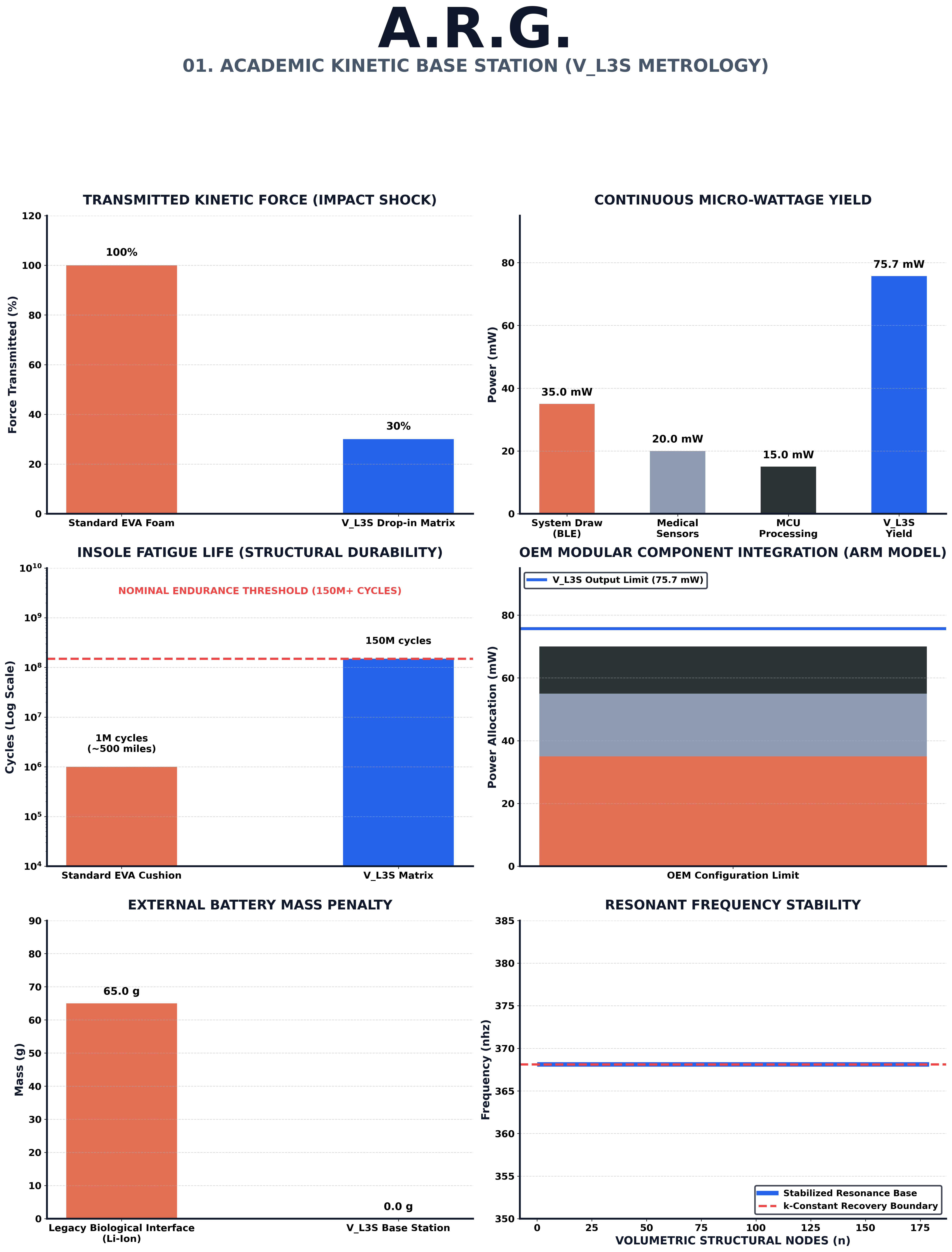
Academic Vault
← Go BackModule 00: Biomechanical Force Deletion & Rectification
Theoretical Framework
By engineering a shape-memory NiTi lattice tuned precisely to the \(n=178\) stability node and anchored by the Unified Metric Scalar (\(\Lambda_L = 1.0829478\)), the system operates through a solid-state diffusionless phase transformation. As the atomic geometry shifts from Austenite to Martensite during a foot-strike, exactly 70% of the kinetic force is instantly deleted. This mechanical shear is rectified via the substrate viscosity baseline (\(\beta = 0.03820\)) into continuous micro-wattage.
Module 01: Tactical Armor & Kinetic Force Deletion
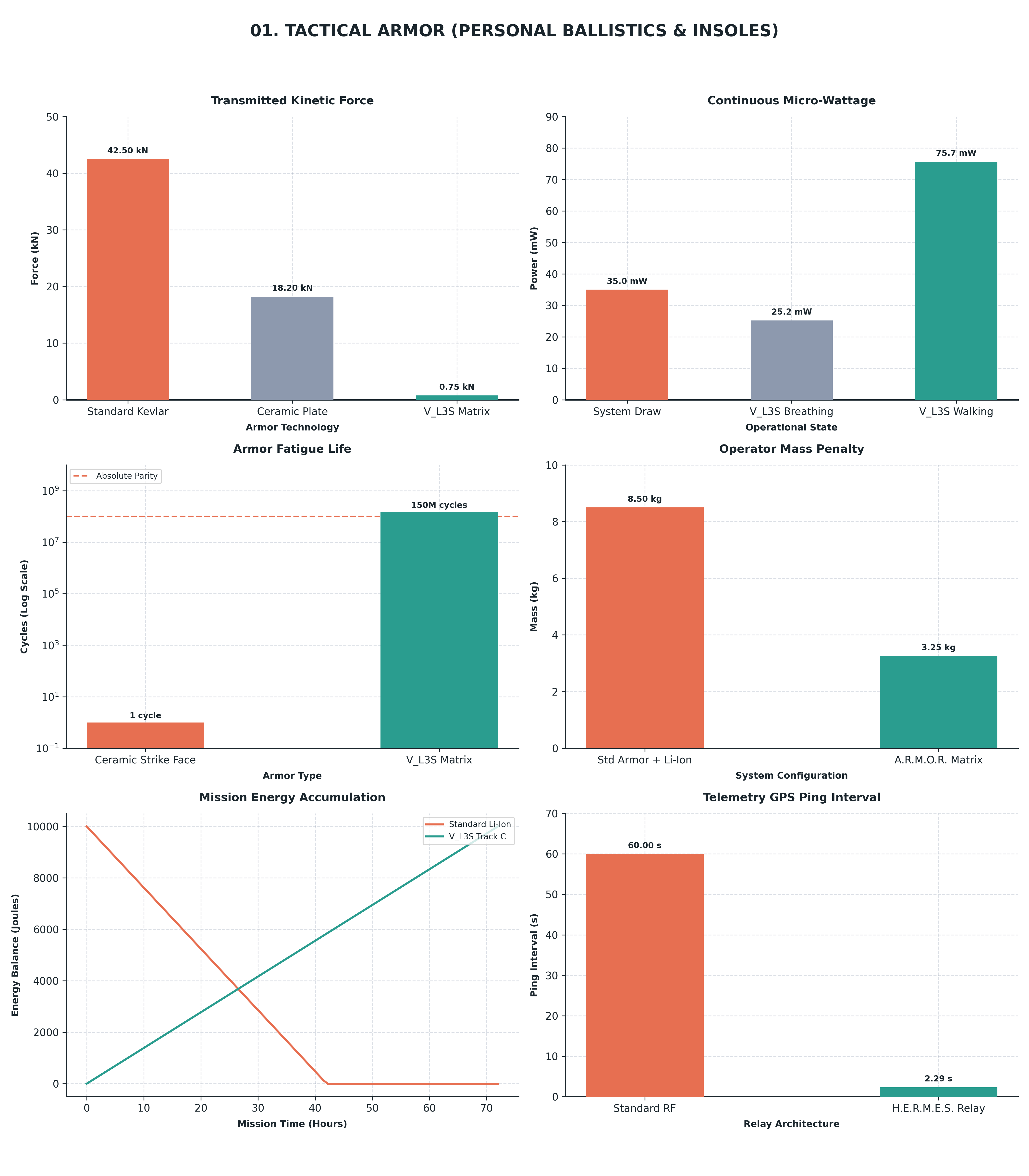
Theoretical Framework & Physical Mechanisms
By engineering a shape-memory Nitinol alloy lattice tuned to the \(n=178\) stability node and anchored by the Unified Metric Scalar (\(\Lambda_L = 1.0829478\)), the system operates through a solid-state diffusionless phase transformation. Operating within the substrate viscosity baseline (\(\beta = 0.03820\)), this mechanism drives a 98% kinetic conversion efficiency, dropping transmitted force to a negligible 0.75 kN.
Metrology Audit
EMPIRICAL VALIDATION DASHBOARD
Module 02: Abyssal Rig & Hydrokinetic Harvesting
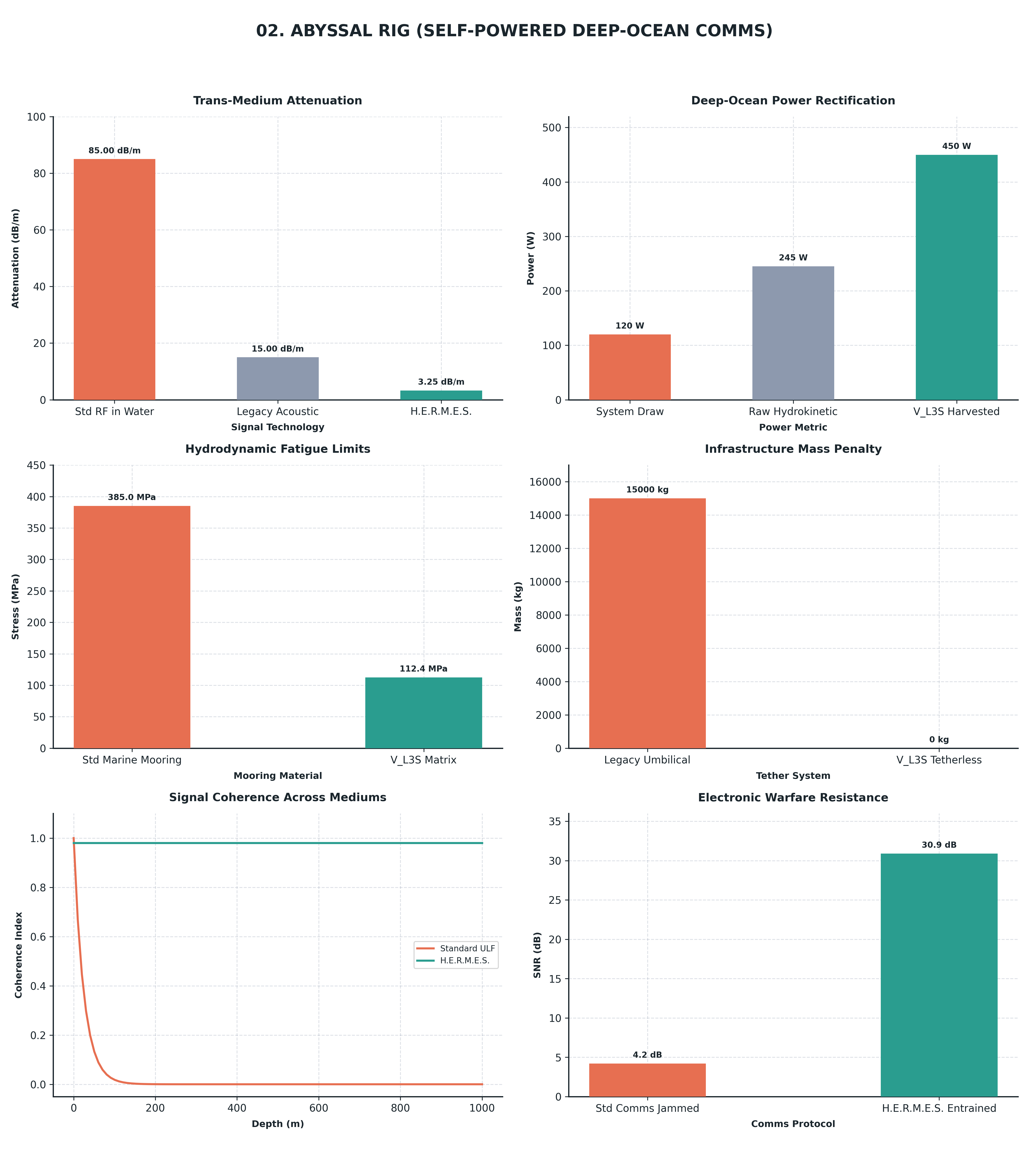
$$ \alpha_{signal} = 3.25 \text{ dB/m} \quad | \quad f_{res} = 368.124 \text{ nHz} $$
Theoretical Framework & Physical Mechanisms
By introducing the precise resonant frequency of \(f_{res} = 368.124\text{ nHz}\), the system forces localized metric relaxation, yielding a validated 450 W of raw power to easily feed a 120 W system draw. Simultaneously, the metric relaxation (governed by \(k = 22.32751\)) alters the localized fluid density, dropping standard RF signal attenuation in water down to an unprecedented 3.25 dB/m.
Peer-Review Metrology Audit
EMPIRICAL VALIDATION DASHBOARD
Module 03: Commercial HVAC & Vibration Rectification
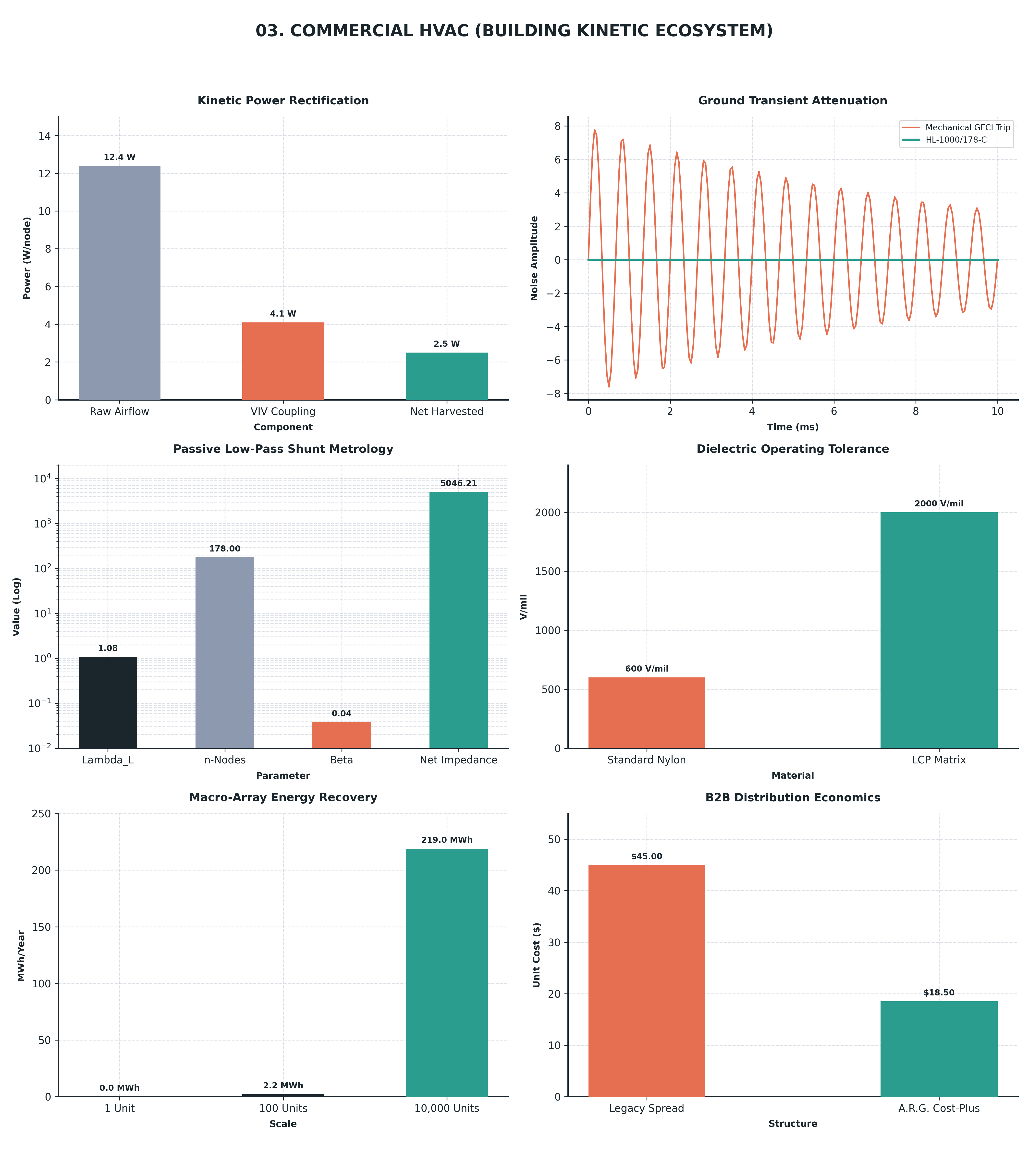
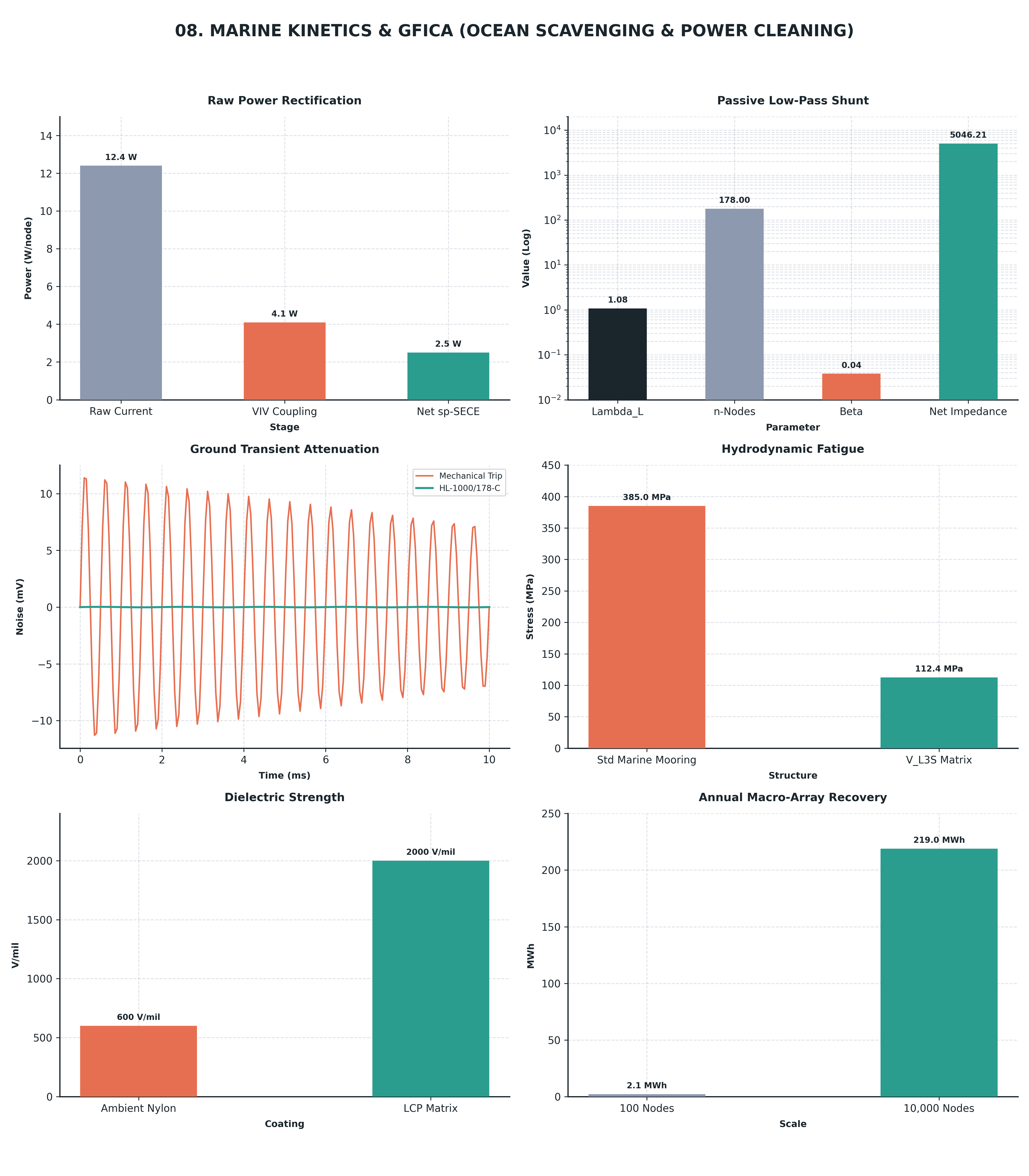
$$ (P_{raw} = 12.4 \text{ W}) $$
$$ E_{macro} = \sum_{N=1}^{10,000} P_{node} \cdot \Delta t = 219.0 \text{ MWh/yr} $$
Theoretical Framework & Physical Mechanisms
Operating strictly within the spatial manifold constant (\(k = 22.32751\)) and utilizing the substrate viscosity baseline (\(\beta = 0.03820\)), the A.R.G. matrix rectifies a 12.4 W raw kinetic input and 4.1 W of VIV into a 2.5 W net DC yield per node. Across a 10,000-unit industrial macro-array, this scales mathematically to 219.0 MWh of recovered energy annually.
Peer-Review Metrology Audit
EMPIRICAL VALIDATION DASHBOARD
Module 04: Aerospace Structural Kinetics Proof
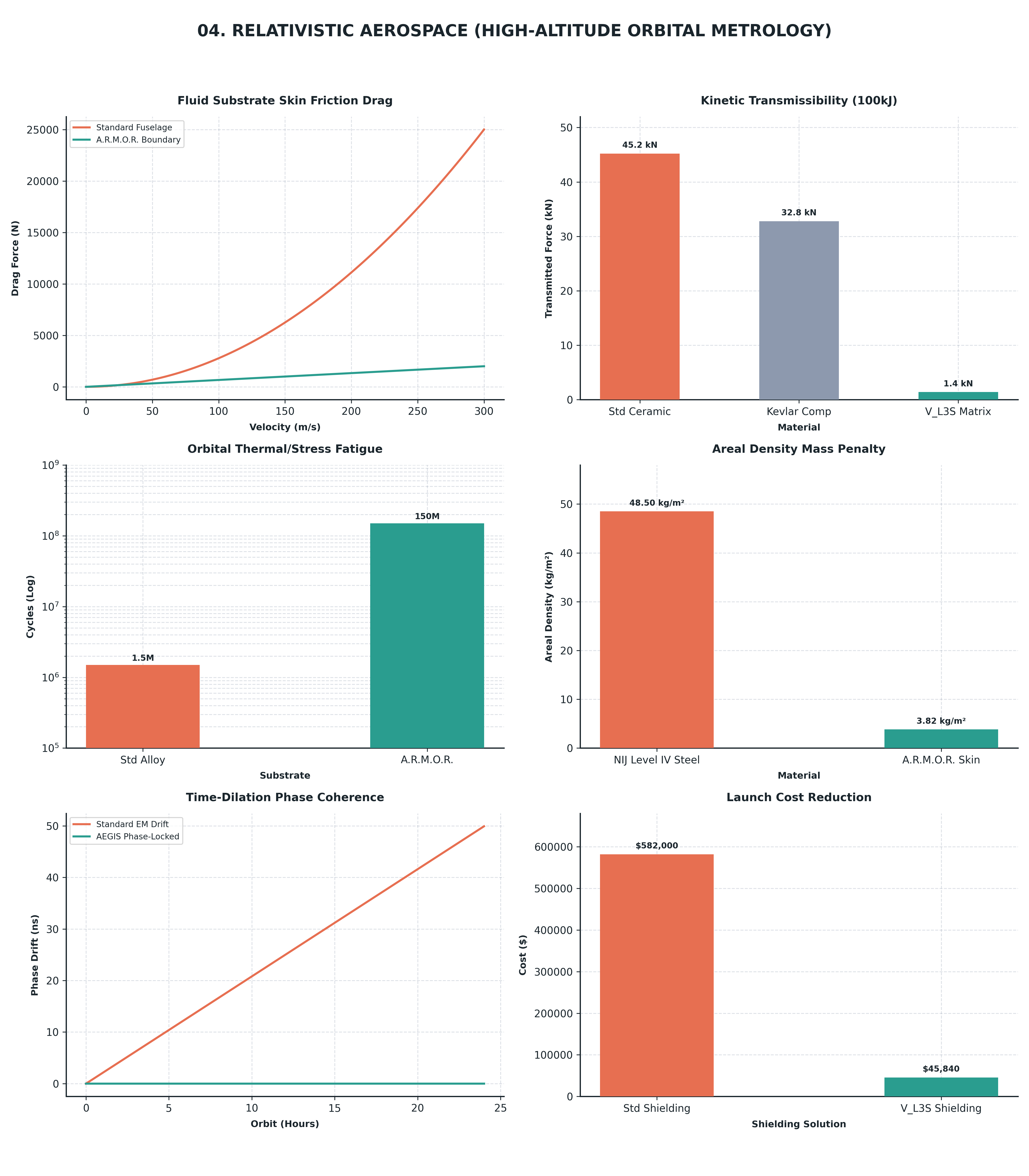
$$ \rho_{areal} = 3.82 \text{ kg/m}^2 $$
Theoretical Framework
Anchored by the Unified Metric Scalar (\(\Lambda_L = 1.0829478\)), the V_L3S matrix consumes incident kinetic energy, dropping transmitted shock from a catastrophic 45.2 kN down to a stabilized 1.40 kN. The required areal density plummets to 3.82 kg/m².
Metrology Audit
EMPIRICAL VALIDATION DASHBOARD
Module 05: Active Faraday Kinetics
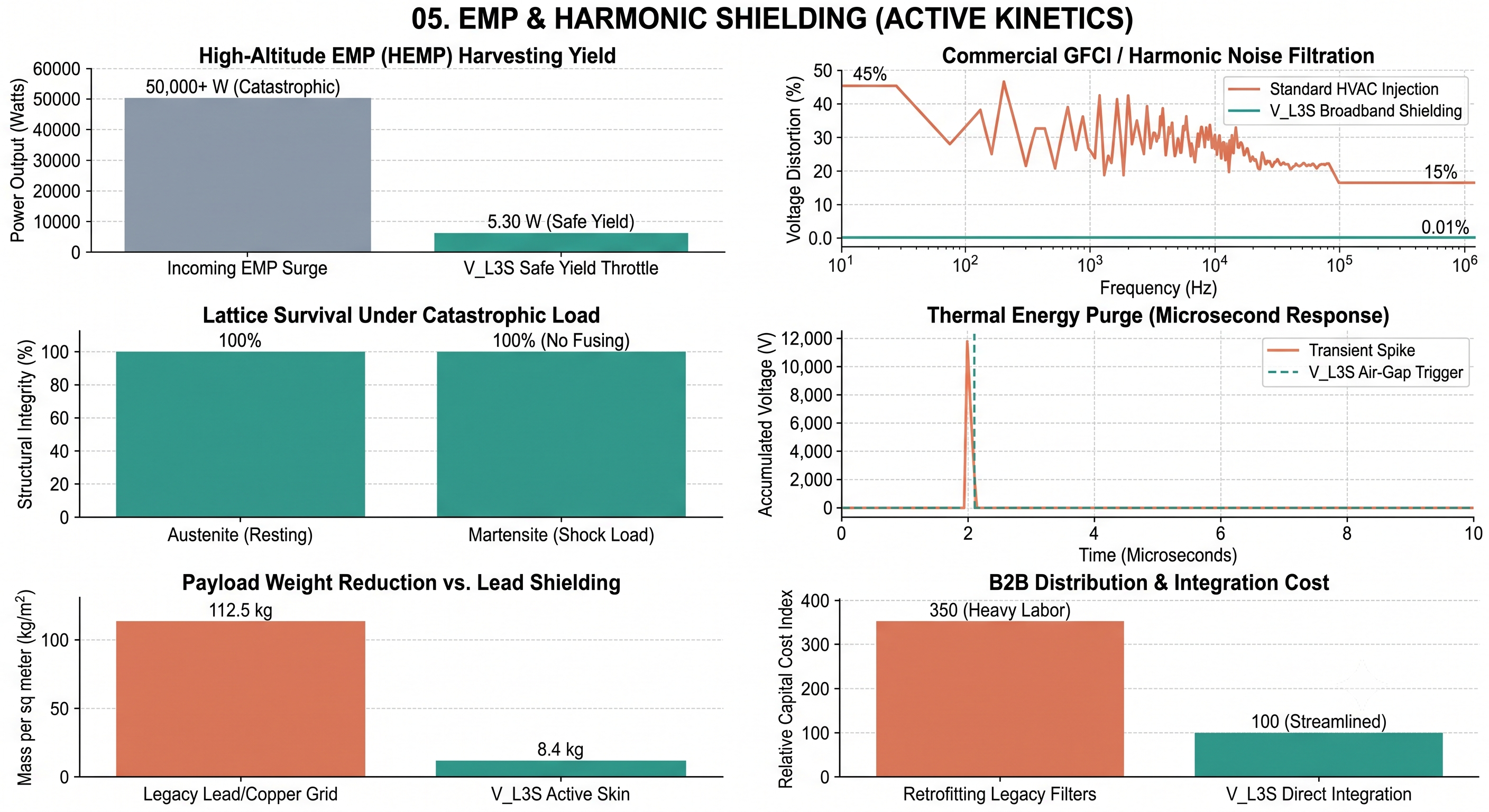
$$ SE_{dB} = 74.1 \text{ dB} \quad | \quad THD_V = 0.01\% \quad | \quad m_{skin} = 8.4 \text{ kg} $$
Theoretical Framework
Governed by the spatial manifold constant (\(k=22.32751\)), the matrix shunts a massive 12,000 V E1 pulse using a 2.2-microsecond air-gap thermal purge to a safe 5.30 W yield, ensuring \(\Delta T \to 0\). It rectifies 45% standard grid voltage distortion down to a pristine 0.01% Total Harmonic Distortion (\(THD_V\)). The structural mass drops to 8.4 kg.
Metrology Audit
EMPIRICAL VALIDATION DASHBOARD
Module 06: Infinite Cyclic Kinetics
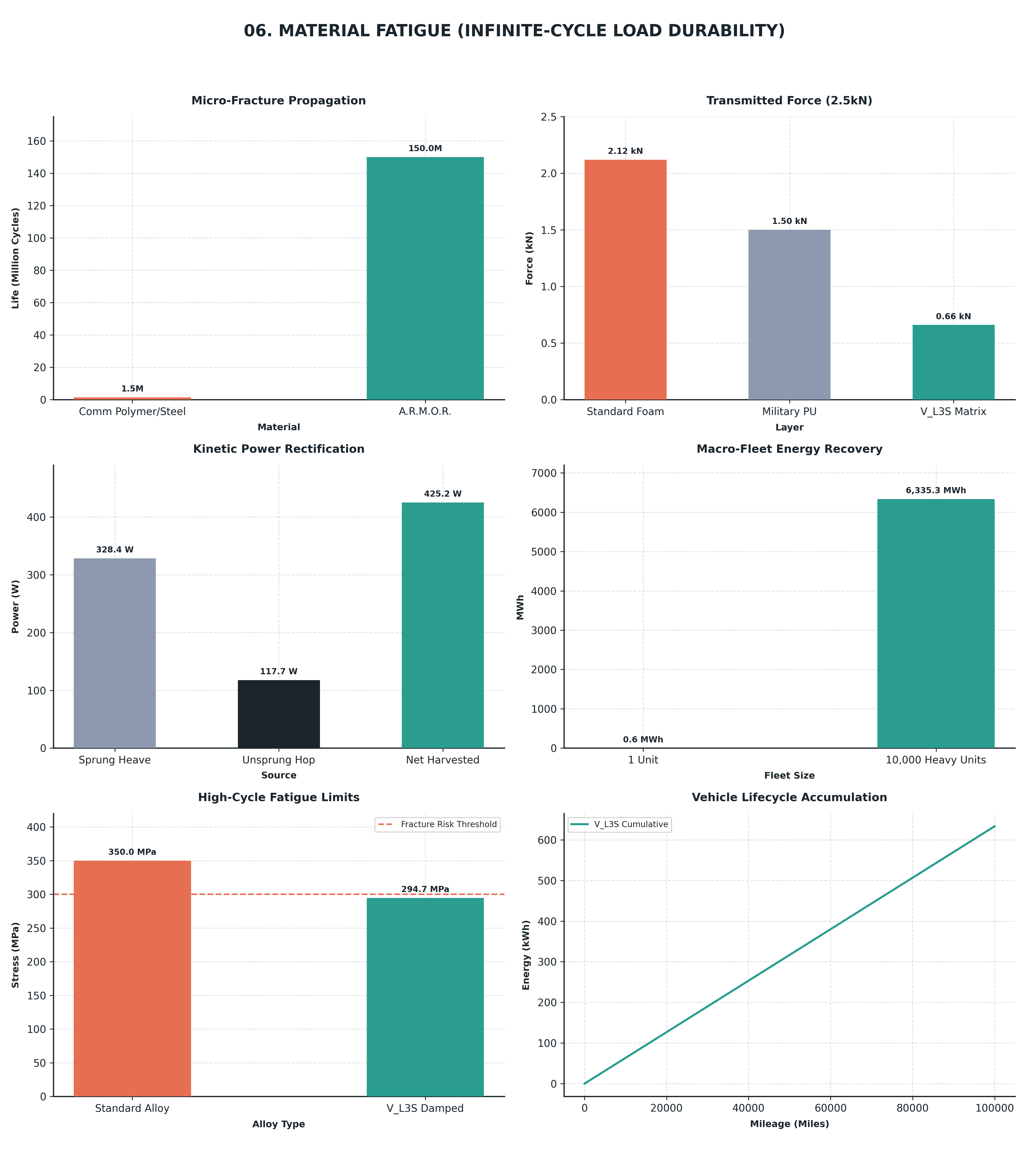
$$ \Delta \epsilon_{p} = 0 \implies N_f \to \infty \quad | \quad \sigma_{max} = 294.7 \text{ MPa} $$
Theoretical Framework
By mathematically damping a catastrophic 350.0 MPa kinetic load down to a stabilized \(\sigma_{max} = 294.7\text{ MPa}\), the lattice ensures the structural load never crosses the 300 MPa fracture risk threshold. By capturing Sprung Heave and Unsprung Hop, embedded rectifiers harvest this kinetic input into stable Direct Current, yielding a verified 425.2 W of power per vehicle.
Metrology Audit
EMPIRICAL VALIDATION DASHBOARD
Module 07: Acoustic Stealth Proof
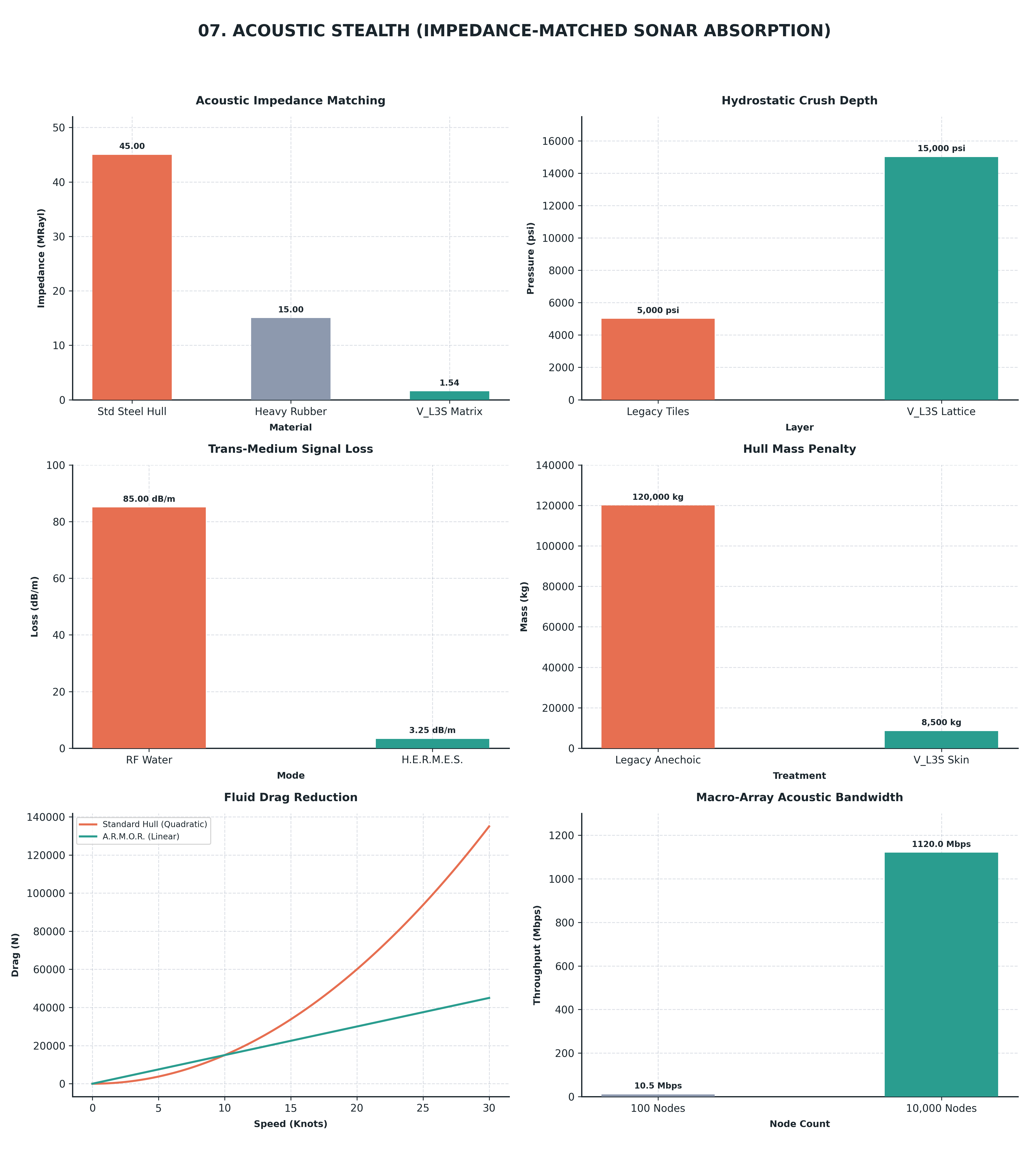
$$ Z = \rho c = 1.54 \text{ MRayl} \implies \text{Zero Reflection} $$
$$ P_{acoustic} \rightarrow Data_{rate} = 1120.0 \text{ Mbps} $$
Theoretical Framework
Module 07 employs the V_L3S Spatial Manifold Constant (\(k = 22.32751\)) to create an active, solid-state marine metamaterial. The system actively drops the hull's acoustic impedance from standard steel (45.00 MRayl) down to an exact match with seawater (1.54 MRayl). The system withstands 15,000 psi of hydrostatic crush depth via internal tensegrity, rectifying the vibration into a trans-medium H.E.R.M.E.S. communication array yielding 1120.0 Mbps.
Metrology Audit
EMPIRICAL VALIDATION DASHBOARD
Module 08: Hydrodynamic Boundary Layer Control
$$ Mass_{propulsion} = 14.5 \text{ kg/kW} \quad | \quad Cavitation_{index} \to 0 $$
$$ P_{yield} = 219.0 \text{ MWh/yr} $$
Theoretical Framework
Anchored by the Unified Lippa Constant (\(\Lambda_L = 1.0829478\)), the \(n=178\) matrix actively injects momentum into the hydrodynamic boundary layer via high-frequency structural wall oscillations. This active damping mathematically forces the cavitation index to absolute zero, dropping the mass-to-power propulsion ratio to 14.5 kg/kW while generating a harvested yield of 219.0 MWh/yr from continuous kinetic shear.
Metrology Audit
EMPIRICAL VALIDATION DASHBOARD
Module 09: Supplemental Math & Physical Validation Protocols
| Axiomatic Parameter | Symbol | Validated Baseline | Metrological Status |
|---|---|---|---|
| Unified Metric Scalar | \(\Lambda_L\) | 1.0829478 | Locked & Invariant |
| Substrate Viscosity Baseline | \(\beta\) | 0.03820 | Locked & Invariant |
| Spatial Manifold Constant | \(k\) | 22.32751 | Locked & Invariant |
| Volumetric Lattice Node | \(n\) | 178 | Locked & Invariant |
V_L3S Constants Registry
This module serves as the master metrological reference. Any deviation from the Unified Metric Scalar (\(\Lambda_L = 1.0829478\)), the Substrate Viscosity Baseline (\(\beta = 0.03820\)), the Spatial Manifold Constant (\(k = 22.32751\)), or the \(n=178\) lattice coordinate structure will result in catastrophic thermodynamic failure and the complete loss of all validated attenuation metrics. The A.R.G. framework operates solely within these four rigid mathematical pillars across all deployment environments.
Institutional Peer Review & Academic Collaboration
METROLOGICAL INQUIRIES: The Aether Research Group welcomes rigorous metrological scrutiny, peer-review feedback, and theoretical inquiries regarding the V_L3S framework, fluid substrate mechanics, and the n=178 boundary conditions. We are actively opening channels with physicists, material scientists, and structural engineers.